How to write a pitch that hit: the Inverted Freytag Pyramid
12/11 - startup life - 8/10 min
Most pitch decks follow the same pattern: problem, solution, market, traction, team, ask.
It works, but it’s cold.
And if you’re presenting to a VC, they’ve already heard thousands of pitches like yours. They already know what you’re going to say, what you’re going to skip, and they’re already thinking about the questions they’ll ask once you’re done. In other words: they’re bored.
So how do you create a pitch that engages and genuinely surprises them?
Simple. Use the Inverted Freytag’s Pyramid.
Freytag’s Pyramid was created for theatre and storytelling, but it works surprisingly well for pitch decks - as long as you adapt it to the business context.
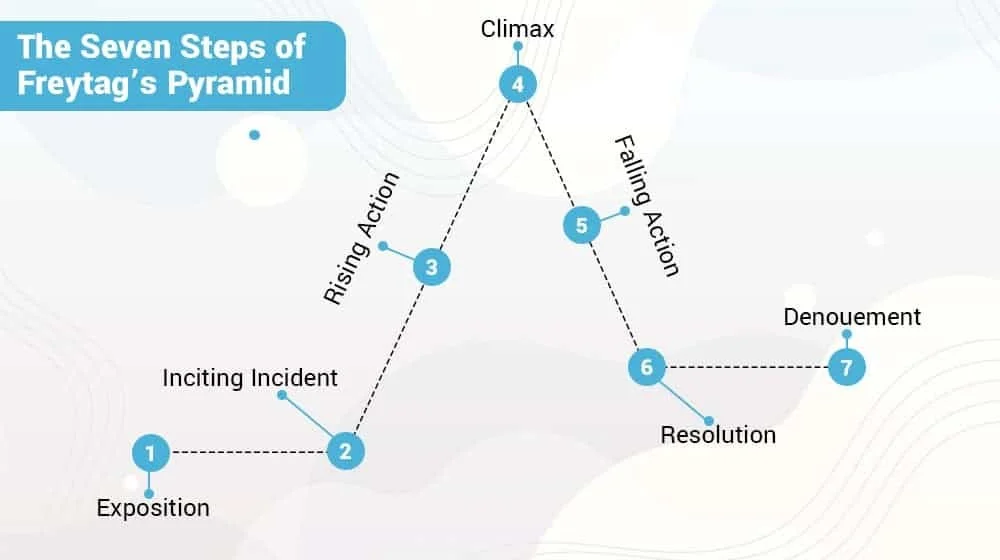
The classical pyramid has the following structure:
Exposition (Introduction)
Presents the context: characters, environment, initial situation.Rising Action
Events complicate the situation and increase conflict.Climax
The moment of maximum tension; the decisive turning point.Falling Action
Consequences unfold and the conflict starts resolving.Denouement (New Equilibrium)
The story reaches a new and stable state.
To make this less abstract, let’s take an example: Toy Story (yes, I know you expected some high-brow literary reference — but hey, it’s a great film).
Exposition
Woody is the leader of the toys; everything is stable until Buzz arrives and threatens his role.Rising Action
Jealousy grows, Woody and Buzz end up outside, and they face increasingly difficult obstacles (Sid, misunderstandings, danger).Climax
Woody and Buzz realize they must cooperate. They accept their weaknesses and become allies.Falling Action
They race back to Andy in a series of hectic scenes (truck, rocket, chase).New Equilibrium
They return home, and is created a new stable form: Woody and Buzz lead together in harmony.
Now back to business — quite literally.
How do we use Freytag’s Pyramid in a pitch deck?
First, we invert the pyramid, we don’t climb upper, we dig deeper
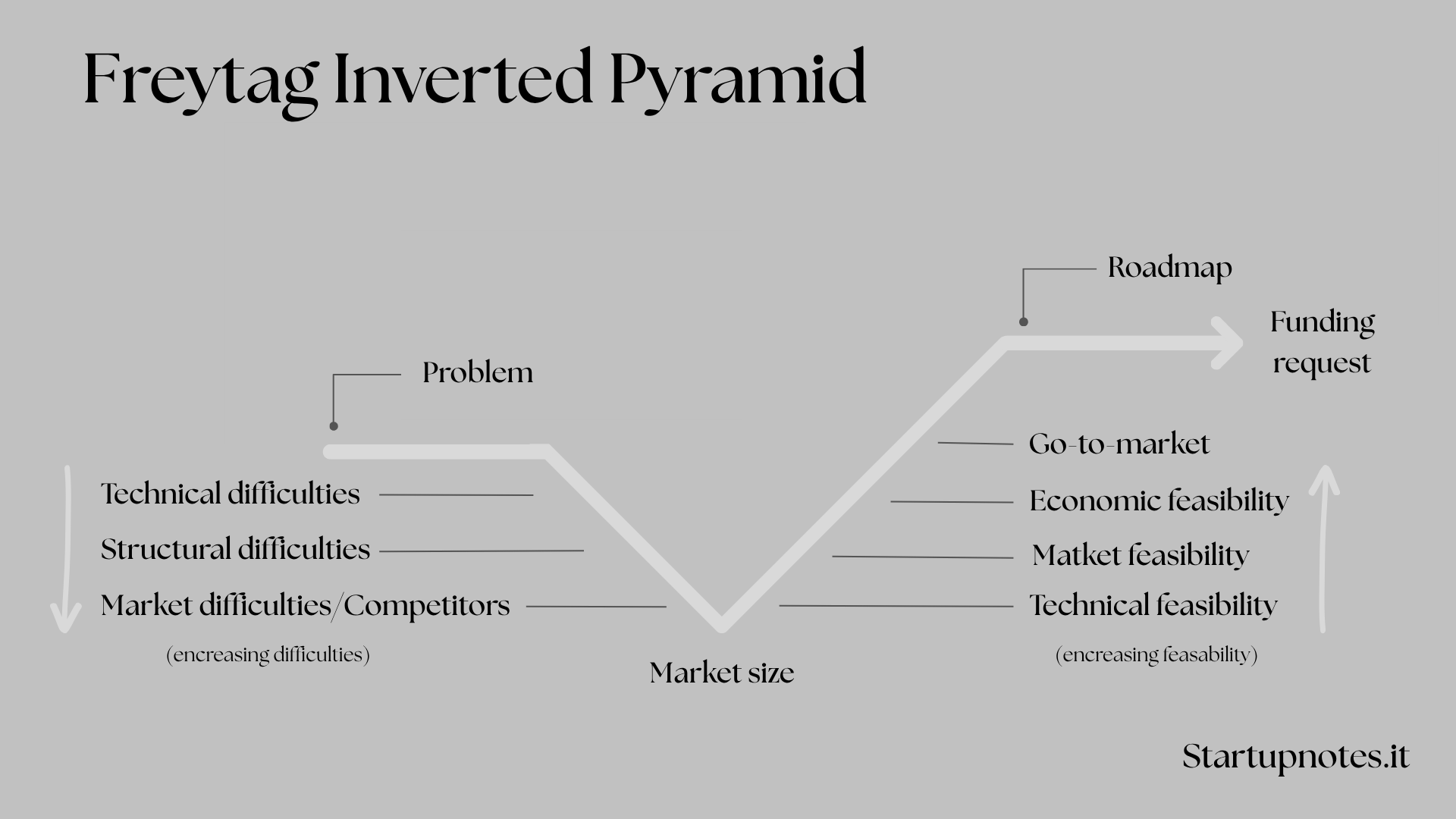
The inverted Freytag pyramid structure:
1. Introduction: the problem
You don’t introduce characters or setting, you introduce the problem. It must feel real, urgent, and unsolved.
You don’t dive into details yet; you give a high-level overview.
The problem isn’t just real it’s deep and complex.
2. Descending into difficulty
The problem isn’t just real, it’s deep and complex.
The deeper you go, the harder it gets, but also the more you show that you know the problem better than the competitors themselves.
a) Technical difficulties
Why current solutions fail at the engineering, logistical, scientific, or operational level.
b) Structural difficulties
Market constraints, infrastructure, regulation, timelines, costs, margins.
c) Competitive difficulties
Why competitors fail despite resources: mistakes, flawed models, wrong approaches, fragile assumptions.
This section builds credibility: you’re not “promising solutions”, you’re demonstrating deep mastery of the problem.
3. Climax: the size of the reward (Market Size)
This is the high-tension moment. After demonstrating how hard the problem is, you now show how valuable it would be to solve it.
The narrative tension is at its peak: the problem is huge, incredibly difficult… and worth billions.
Here you include the market size, total and adressable market.
4. Rising back up: proving feasibility
Now you climb upward, rebuilding confidence step by step with a logical crescendo.
a) Technical feasibility
How you overcome the exact obstacles described earlier: technology, IP, processes, patents.
b) Social / market feasibility
Trends, early adopters, traction, behavioral data, partnerships, early contracts.
You prove that real customers genuinely want this.
c) Economic feasibility
Business model, margins, unit economics, scalability.
Here you include metrics like margin, CAC, LTV, MRR/ARR, retention, churn, burn rate, runway.
You show not only that it works — but that it pays off.
d) Go-to-market
How you enter the market, with whom, and in what order.
Proof that it’s not only feasible — it’s executable.
Pay attention to the team:
If the core difficulty is technical, the team slide goes in the technical section.
If the core difficulty is commercial, it goes in the relevant later section.
This section completely flips perception: the listener goes from “this is impossible” to “it’s inevitable that you’ll succeed”.
5. New equilibrium (Denouement)
This is the “new world” after the climax. You show a credible roadmap leading to a stable, mature state; where the startup is no longer a startup but a solid company.
This is where the roadmap goes.
Finally, you close with your funding request.
Good luck and be creative
Author: Marco Carabelli
Based on personal thoughts